Refining the Engine: How Deep Postures Drive Neurological, Fascial, and Cardiovascular Adaptation in Chen Taijiquan
Updated: May 20
On Da Jia, the big posture training frame that is simultaneously low, wide, and fully extended
The discrepancy between the deep, expansive postures seen in Chen-style Tai Chi forms and the upright, compact posture used in martial application may seem like a puzzle. If fighting is done high and small, why does training insist on going low, wide, and fully extended?
The answer goes beyond simple strength, flexibility, or conditioning, and gets to the heart of how the unique properties of the Chen-style Body Method are trained. Deep and expansive training postures function as a deliberate constraint, a controlled environment designed to expose inefficiency and force adaptation across three distinct but interdependent systems: the nervous system, the cardiovascular system, and the fascial network. Each adapts on its own timescale. All three require depth to develop optimally.
The result is not movement that is permanently large or low, but a body that has learned how to organise itself elastically and coherently, so that when posture becomes upright and movement becomes small, power and connection remain effortlessly present.
1. The Low Posture as a Magnification Lens: Amplifying the Signal of Structural Inefficiency
In an upright stance, structural inefficiency is easy to sustain invisibly. Bracing, blocked pathways, and kinetic chain discontinuities all produce signals too faint or too diffuse to act on, something feels slightly off, but its location and nature remain unclear. A deep, wide stance raises the resolution of that signal. The increased demand and full fascial extension amplify what was vague into something specific and locatable: the stuckness registers at the precise point where the kinetic chain is breaking, the blockage is felt at the joint or fascial plane where transmission is failing rather than as undifferentiated background noise. The practitioner doesn't just feel that something is wrong, they start to feel where exactly the issue is located.
Part of the reason is leverage. In a wide, deep stance the distance between the kua and the centerline is substantially greater than in an upright posture. A small tension in the hip musculature, the kind that passes unnoticed in a compact stance, produces a proportionally larger displacement at that distance. The hip rides up unmistakably. The error that was below the threshold of perception in an upright stance becomes impossible to ignore in a wide one. The width of the stance is not incidental. It is a lever that amplifies structural error at the root into a signal the practitioner cannot attribute to anything other than what it is.
The low posture is a high-load, slow-speed diagnostic for the kinetic chain. When the structure is optimally aligned, removing bracing and unlocking the hips, the load on the legs increases significantly, feeling much more demanding and exhausting than a rigid stance. This increased demand is what makes kinetic chain discontinuities perceptible, the pathway either transmits cleanly under load or it doesn't, and at this demand level the difference is unmistakable.
Any reliance on wasteful, noisy patterns, like co-contraction or passive bracing, immediately blocks the kinetic chain and prevents the elastic transmission of force. This feeling of mechanical blockage creates the necessary feedback loop that forces the CNS to abandon these wasteful patterns and discover the cleanest, most elastic path for force transmission.
Deep and expansive postures function as an error-amplification system. Load increases signal resolution, range increases visibility, and full fascial extension removes slack. When all three are present simultaneously, the location and nature of structural inefficiency becomes perceptible with a precision that lower-demand conditions cannot provide. The nervous system is shown, with unusual clarity, exactly where improvement is needed.
2. Building the Physical Foundation: Strength, Song, and Stability
The ultimate goal is refinement, but refinement requires capacity. Low postures are not an aesthetic choice, they are a developmental necessity. Before nervous-system subtlety and efficient patterning can emerge, the body must first be physically capable of sustaining correct structure under load.
Connective Tissue Flexibility: Deep stances physically compel the connective tissues, fascia, and musculature surrounding the hips and kua to adapt to a greater usable range of motion. This flexibility is the essential physical precondition that allows the body to sink deeply enough to load the Dang correctly, the compressive pelvic arch formed by the inner legs, adductors, and pelvic floor that provides the stable structural base from which all rotation and force expression above it become possible. Without this adaptation, spirals fragment, force leaks upward, and internal mechanics remain theoretical.
Muscular Strength: Low posture training builds foundational leg and hip strength in a way that cannot be bypassed or simulated. This strength is not maximal or explosive, it is structural, positional strength, developed precisely in the joint angles Taijiquan requires. Without sufficient muscular strength, the posture collapses, joints compensate, and relaxation becomes collapse rather than Song. Strength is not opposed to internal work, it is what makes internal work possible
Muscular Endurance, Cardio, and Breath-Regulation: Sustained low postures develop deep muscular endurance while simultaneously challenging the cardiovascular system and breath regulation. This trains the practitioner to maintain calm, continuous breathing under load, a prerequisite for nervous system refinement and internal continuity.
Tendon, Ligament, and Joint Strength: Bearing load in structurally correct alignment strengthens the tendons, ligaments, and joint capsules, creating a resilient frame capable of safely transmitting force. This prepares the body not only to issue power but to absorb and redirect it without injury.
Injury Prevention Through Optimal Alignment: Low posture training exposes alignment errors immediately. When the joints are stacked correctly, load distributes through bones and connective tissue rather than accumulating in vulnerable structures. Correct alignment under load is not merely safe, it is educational.
The Precondition for Song: Most importantly, this accumulated structural capacity provides the foundation required for genuine internal relaxation. The classical principle holds: if the legs are not strong, the upper body cannot relax. Only when the lower body is stable, strong, and trustworthy does the upper body relinquish unconscious bracing, and at that point it can truly Song, sitting comfortably on the frame of the legs to integrate into whole-body movement.
Taken together, these adaptations: connective tissue flexibility, muscular strength, endurance, joint resilience, and optimal alignment, create a body capable of sustaining complex load patterns. In the language of Mechanical Ecology, low-posture training teaches the body to self-organize under mechanical constraints, allowing the nervous system and musculoskeletal system to discover efficient, resilient, and elastic patterns naturally.
3. Leg Winding: Why Low Stances Are Irreplaceable
While spiraling is often highlighted in the torso and arms, the legs themselves must coil and wind under load to fully express Taijiquan’s spiral mechanics. True leg winding is only possible in a sufficiently deep and wide stance, where the hips, knees, and ankles are loaded across a full range of motion to:
Engage fascial spirals through the legs: Deep stances allow the fascia surrounding the thighs, calves, and feet to experience torsional stretch, creating continuous pathways from the feet to the Kua.
Develop interoceptive mapping of lower-limb spirals: Small or upright postures limit hip rotation and ankle torsion, preventing the nervous system from accurately sensing and refining coiling mechanics in the legs.
Integrate the legs into whole-body spirals: The deep stance connects leg winding to the torso and arms, ensuring that the kinetic chain from foot to hand is coherent and elastic, the essential condition for unbroken spiralling through the entire structure.
What the leg winding work described above is ultimately building, across the full developmental timescale of deep stance training, is the Dang: the compressive arch of the inner legs and pelvic floor that sits beneath the upper body as a stable, elastic cradle. The Dang cannot be developed in high stances because the arch geometry that creates the necessary compressive loading simply isn't present at that height, the structural adaptation depends on depth in the most literal sense. The Dang is always present as an anatomical structure, what deep stance training develops is an open Dang: one that is elastically engaged, compressively loaded, and fully participating in force transmission rather than structurally dormant.
The mechanical case for this begins with why spirals are the preferred shape for force transmission in the first place. In engineering terms, a helical structure under load distributes stress along its entire length rather than concentrating it at a single point. This makes it both more resilient and more efficient as a transmission pathway, the same principle that underlies coiled springs, twisted cables, and bone microarchitecture. In the context of rooting, a leg that is structurally wound creates a continuous helical column capable of receiving ground reaction force and transmitting it upward without dissipation. An uncoiled leg under load braces, it resists rather than transmits, absorbing and losing energy at its weakest point rather than conducting it through. The spiral is not a stylistic choice. It is a more mechanically effective shape for what rooting actually requires.
But the spiral can only do this work if it is loaded across its complete extent. Partial torsion, the kind available in high or narrow stances, tensions only a segment of the fascial chain, leaving the rest slack. Force transmitted along an incompletely tensioned pathway leaks where the tension ends. Deep stances are the prerequisite for full torsional loading from foot to kua, which is the prerequisite for a coherent, unbroken transmission line.
This is also why the interoceptive development cannot be shortcut. The nervous system can only map a pathway it can feel, and it can only feel a pathway that is under genuine load. Shallow stances limit hip rotation and ankle torsion enough that the proprioceptive signal from the lower limb spiral remains incomplete, the nervous system receives data from part of the chain, but not the whole. Practitioners who train predominantly high often develop arm and torso spirals that feel internally coherent but remain disconnected from the ground, because the lower map was never completed. Full leg winding in a deep stance is what closes that circuit, giving the CNS the high-resolution feedback it needs to integrate the leg spiral into a single continuous chain from foot to hand.
4. Three Adaptation Systems, Three Timescales
This is where the full picture of what deep stance training achieves becomes clear, and why practitioners who train with consistently high stances are shortchanging themselves more than they typically realise.
Deep stances drive adaptation across three distinct systems simultaneously. They are interdependent and mutually reinforcing, but they operate on different timescales.
Neurological Adaptation: Weeks to Months, and Beyond:
The fastest pathway. The CNS can reorganise motor patterns, reduce co-contraction, and refine kinetic chain sequencing within weeks of consistent practice. Practitioners feel this relatively early, movement becoming cleaner, less effortful, more coherent. The error-amplification mechanism of the deep stance is what makes this rapid refinement possible: inefficiency has nowhere to hide, so the nervous system is forced to find cleaner solutions quickly.
This is the adaptation that is most immediately perceptible and most discussed in the literature on internal arts training. But it is only the first layer.
Cardiovascular Adaptation: Months to Years, and Beyond
Less discussed, and largely absent from conventional accounts of Tai Chi practice, the cardiovascular consequences of long-term deep stance training may be among the more physiologically interesting questions to emerge from examining this practice seriously. There is a paradox at the heart of this: the practice that produces metabolic efficiency as its long-term adaptation is itself metabolically costly as a training method, and that costliness is the mechanism.
Deep stances place sustained high metabolic demand on the largest muscle groups in the body: quadriceps, glutes, and adductors working under substantial isometric and quasi-isometric load across thousands of hours of time under tension. This demand requires cardiac output to meet it. But the deliberate respiratory suppression that is central to Chen-style practice, keeping the breath slow, deep, and controlled precisely when it wants to accelerate, limits the conventional heart-rate response to that demand. The result is a persistent mismatch: genuine metabolic load in the largest muscles in the body, with the cardiac rate response systematically braked.
That mismatch appears to drive two distinct downstream adaptations, operating through different mechanisms on different timescales.
The first is peripheral: Sustained quasi-isometric loading of the quadriceps, hamstrings, and glutes creates a chronic localised hypoxic stimulus in precisely the muscles that contribute most to whole-body oxygen consumption. That signal drives mitochondrial density increase and capillary proliferation in those muscle groups, elevating the capacity for oxygen extraction without requiring cardiac structural remodelling. The heart delivers blood. The muscles become progressively more efficient at extracting oxygen from each litre delivered.
The second is autonomic: Years of maintaining metabolic demand with respiratory rate deliberately suppressed trains the nervous system to keep the parasympathetic brake engaged under load, progressively deepening vagal dominance and widening the functional operating range of the autonomic system. This produces the unusually low resting heart rates observable in some long-term practitioners, not because the heart has structurally enlarged, but because the nervous system has learned to hold it at an unusually low floor. The adaptation is software rather than hardware.
Both adaptations depend critically on the stances being genuinely deep. High stances short-circuit the peripheral mechanism because the metabolic demand in the lower limb musculature drops below the threshold required to produce the chronic hypoxic signal that drives mitochondrial adaptation. They short-circuit the autonomic mechanism because the metabolic load that respiratory suppression is working against diminishes, respiratory suppression without genuine metabolic demand gives the autonomic system nothing to adapt to. The depth is not an aesthetic preference or a traditional convention. It is load-bearing in the most literal physiological sense, and both cardiovascular adaptations depend on it entirely.
Fascial Adaptation: Years to Decades
The slowest pathway, and the one most commonly misunderstood. Fascial tissue has poor vascularity compared to muscle, which means remodelling cycles are much longer, meaningful fascial reorganisation typically takes months to years, and the deeper structural changes of long-term practice accumulate across decades.
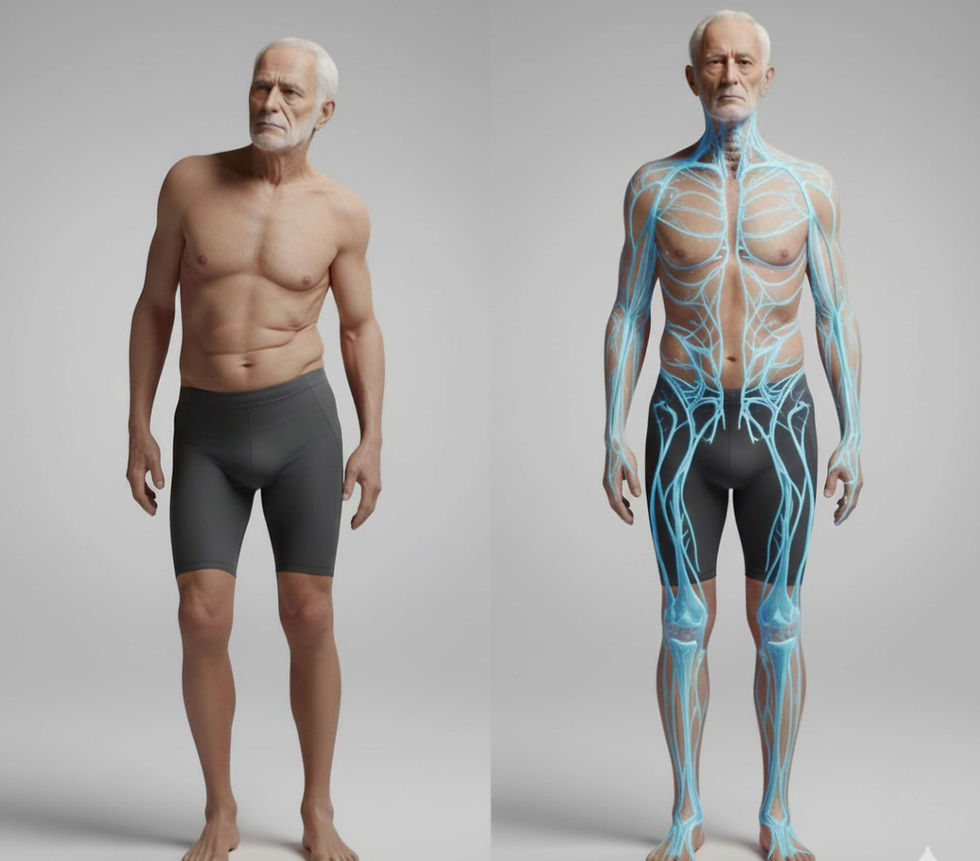
Deep stances are essential to this process for a specific reason. The torsional loading under depth, the leg winding described above, tensions the fascial network across its complete extent along the helical paths that Chan Si Jin requires. Pathways that are never loaded across their full length never get mapped. The fascia cannot transmit coherently along routes that have never been tensioned end to end. High stances simply cannot reach the fascial territory that deep stances access, which means practitioners who avoid depth are not just developing less fascial elasticity, they are leaving entire force transmission pathways undefined. The full mechanistic account of how fascial remodelling operates at the cellular level is examined in the companion piece.
The functional expression of all three adaptations working in tandem, what the system becomes when neurological refinement, cardiovascular efficiency, and fascial coherence are operating together, is examined in The Low-Cost Engine: How Chen Taijiquan Reduces Autonomic and Metabolic Cost.
6. The Upper Body in Big Posture: Fascial Extension as Diagnostic Tool
The lower body sections describe what Da Jia does for the legs, loading the fascial network across its full torsional range, mapping spiral pathways from foot to kua, creating the metabolic and structural conditions for genuine adaptation. Big posture extends the same logic upward and outward: the arms, shoulders, back, and ribcage extended to their maximum geometric range, tensioning the upper body fascial network across its complete extent.
The upper body is not challenged by gravitational load in this dimension. The demand is elastic, maintaining continuous fascial tension across large distances without the structure collapsing at the shoulder or across the back. At compact range, discontinuities in that fascial connection are below the threshold of perception: the distances are short enough that local muscular effort quietly bridges the gaps without the practitioner noticing. At full extension, the slack is gone. The fascial network is either continuous end to end or it isn't, and the interoceptive signal makes the difference immediately perceptible, a felt break in the elastic coherence, a loss of the whole-body connected quality that correct extension produces.
This is the same mechanism that leg winding exploits, fascial tissue loaded to its full extent produces a richer, cleaner interoceptive signal than tissue operating well within its range. The geometry and anchoring differ, but the principle is identical: full-range spiral loading creates the conditions under which fascial continuity or its absence becomes perceptible.
Training big forces the CNS to map connection through the Five Bows at maximum range. If the kinetic chain stays coherent when the hand is at its furthest point from the centre, maintaining that coherence in a compact combat posture becomes structurally effortless, the map has been drawn at its largest scale, and the smaller expression is already contained within it.
7. Big and Deep Postures as a Teaching Amplifier
Beyond their effect on the practitioner's own interoceptive signal, deep and expansive postures serve a crucial pedagogical function: the same amplification that makes structural error perceptible from the inside makes it equally visible from the outside. A raised kua, a collapsed knee, or a disconnected arm cannot hide when the structure is fully opened, the teacher sees what the practitioner may not feel.
Equally important, corrections land with corresponding clarity. In a small or upright posture, adjustments often register only intellectually. In a big posture, the same correction produces an immediate internal response, a more coherent load path, a more refined elastic sense of connection. The nervous system receives high-resolution feedback.
This makes big posture training a high-bandwidth communication channel between teacher, student, and nervous system. The larger the frame, the clearer the signal in every direction.
8. Large Coiling as the Blueprint for Micro-Spiralling
Taiji mechanics are built on two spirals: large-range winding visible in form, and small-range micro-spiralling used in application.
Deep and wide postures exaggerate the large-range spirals so the interoceptive system can map the pathway and the CNS can refine the timing and sequencing. The movement pathway used to coil the body 45 degrees in a big posture is the exact same chain used to coil 5 degrees in a fighting posture. By drawing the map in giant, bold strokes, you provide the CNS with high-definition data.
Deep stance spirals use maximum range to create the neural pattern. Upright spirals express that same pattern with minimal range.
Conclusion
Deep and big stance training is not about fighting low or wide. It is a laboratory for building the internal architecture that upright postures require, a neuro-mechanical conditioning process that teaches the nervous system where the body is safe, how force should pass, and when effort is unnecessary.
In that laboratory, flexibility develops the range required for complete mapping, load forces neuromuscular refinement by making inefficiency unsustainable, and torsional depth defines the fascial pathways that coherent force transmission depends on. Each adaptation takes time, and none transfers without the depth that makes it possible. High stances produce some of the first adaptation and almost none of the second and third. The depth is not optional variation, it is load-bearing in the most literal sense, and the entire metabolic and fascial argument depends on it.
What remains, when the posture rises, is a body that is quick, subtle, and responsive in upright posture, powerful across a range of motion that looks, from the outside, almost too small to matter.
The low and the big are for building the engine. The high and the small are for using it

Comments