The Myofascial Void: The Architecture of Absence
Updated: Mar 5
In the study of internal mechanics, we usually notice restriction first. It announces itself through tightness, stiffness, and reduced architectural capacity. We encounter Myofascial Locks: the dense, fossilized regions where excess cross‑linking and neurological guarding have clamped the structure shut, requiring painstaking opening and unbinding to remodel the fascia. For the modern person, the Lock is usually the primary adversary, a wall of tension built by stress and high-threshold bracing.
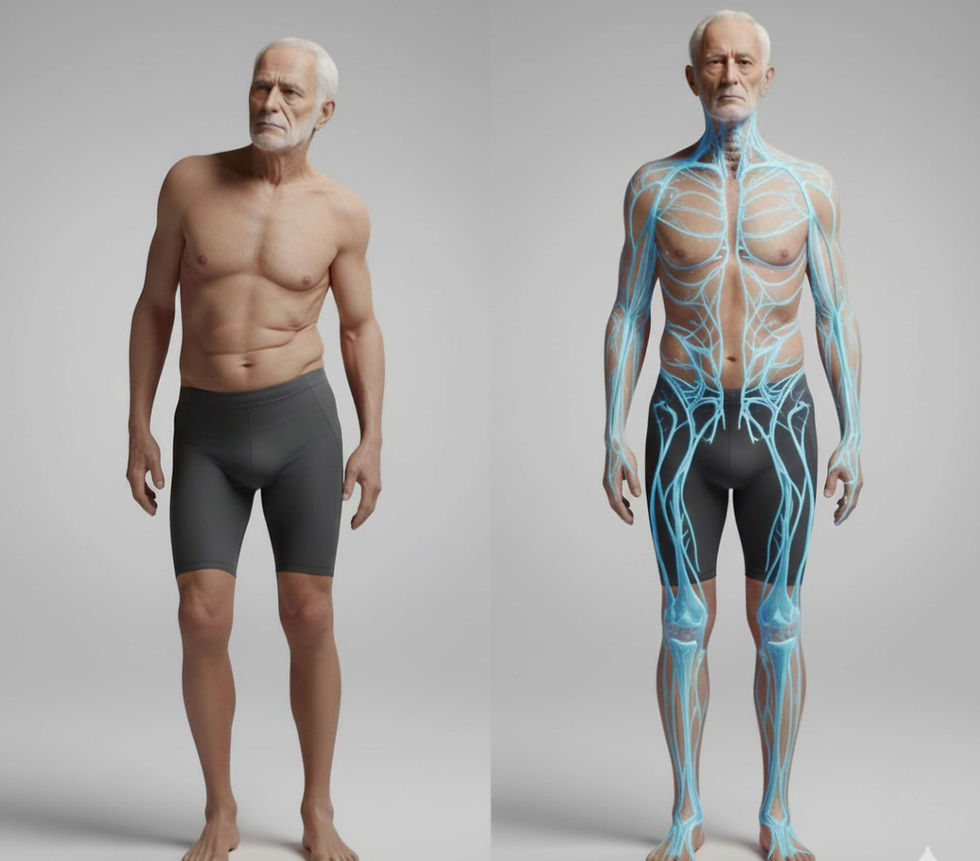
But structural failure has a silent, often overlooked counterpart: The Myofascial Void. While the Lock is a wall you crash into, the Void is a trapdoor you fall through. It is a state of structural absence rather than excess, where the fascial network has lost its continuity, its tensile participation, and its capacity to transmit load. It is the signature of the "flaccid" practitioner, one who has found softness but in the absence of an integrated tensile web.
Together, the Lock and the Void define the two primary architectural failures, forms of Biomechanical Debt, that Taijiquan must resolve to make refinement possible.
1. What Is the Myofascial Void?
The Myofascial Void describes regions of the body where the fascial network is structurally disengaged and neurologically offline. These areas are not blocked; they are absent from the load path. As a result, force bypasses them entirely and is dumped into nearby joints or denser, rigid structures.
Subjectively, the Myofascial Void most reliably identified by the inability to feel stretch, engagement or tensile continuity: the practitioner cannot locate an end-range or elastic response because the tissue is not participating in tension.
Where the Myofascial Lock feels tight, the Void feels invisible. A Void is not neutral; it is a structural liability that forces compensation elsewhere, often creating Locks upstream or downstream to prevent total collapse. In a Myofascial Void, movement may collapses into a joint because surrounding tissue fails to transmit load. This occurs largely unnoticed, creating a hidden structural liability that may compromise the joint over time.
The Biological Reality of the Void: Signal, Silence, and Atrophy
At the cellular level, fascia is a signal-driven tissue. It remodels itself in response to mechanical input through mechanotransduction, the process by which physical load is converted into biological instruction. Fibroblasts, the architects of the fascial web, rely on the constant “ping” of tensile and shear forces to determine where collagen should be laid down, how fibers should align, and whether the ground substance remains hydrated and volumetric. When a region becomes a Myofascial Void, that signal disappears.
Without tensile engagement, fibroblast activity declines. Collagen fibers become sparse or poorly oriented, and the extracellular matrix begins to thin. The ground substance, which depends on pressure to maintain hydration, depressurizes and loses its capacity for glide. This is not relaxation, it is atrophy through silence.
From a structural perspective, this represents a failure of biotensegrity. In a healthy system, every “string” in the web carries tension and contributes to global integrity. In a Void, the string has gone slack.
The Neurological Feedback Loop
The consequences are not only mechanical, but neurological. Fascia is one of our most sensorily dense tissues. When a region ceases to bear load, its mechanoreceptors: Ruffini endings, Pacinian corpuscles, Golgi receptors, stop firing. The brain quite literally stops listening. As sensory input degrades, the cortical representation of that tissue fades, and the ability to voluntarily organize or reintegrate it diminishes further, illustrating how changes in load transmission directly shape interoceptive awareness.
This creates a closed feedback loop: because the tissue carries no load, it provides no signal; because it provides no signal, it cannot be recruited.
A Void is therefore a territory that has been abandoned, biologically, neurologically, and structurally. Left unaddressed, it becomes a latent instability that must be managed by compensatory tension elsewhere.
Corrective work does not “release” a Void. It reintroduces signal, restoring tensile participation so the tissue can once again be sensed, hydrated, remodeled, and reintegrated into the body’s load-bearing web.
4. When Relaxation Becomes Collapse
A critical error in internal practice is the assumption that all dysfunction is resolved through release. In the Void, there is nothing to release.
This is where a misunderstanding of Song (release/looseness) becomes a liability. If you apply the logic of total relaxation to a Myofascial Void, you do not achieve Song; you achieve flaccidity. Further "softening" only deepens the collapse and blunts interoceptive feedback.
True Song is neurological release within engaged tissue: the absence of unnecessary tension even as the structure carries load. In the case of a Myofascial Void, this requires cultivating Peng, active, elastic tension that transmits force without resorting to muscular bracing, effectively "knitting" the web back together.
5. The Subtractive Stream: Removing Disconnection
Although the Myofascial Void appears opposite to rigidity, it is still resolved within the Subtractive (Corrective) Stream of Fascial Remodeling. We are not "adding" strength in the conventional sense. Instead, we are removing the interference of structural absence and the habit of bypassing specific regions of the load path. What is subtracted is not tension but discontinuity. By bringing these "silent" zones back into the load path, we remove the friction caused by a fragmented body.
Conclusion
Neutral architecture is not the absence of tension. It is the presence of distributed, elastic integrity. The Myofascial Void must be filled, not with force or muscle, but with coherent load, to allow refinement to progress.
The art does not merely loosen the tight places; it teaches you where you were never truly there at all. Once the web is whole, the Void is no longer a liability. it has become a functional part of the elastic, integrated structure.


Comments