The Compounding Architecture of Early Bracing
Updated: Aug 14
Within the Mechanical Ecology framework, Biomechanical Debt accumulates along two independent axes. The external ecology is everything the body has physically encountered: loading history, sport, occupational demand, injury, and the debt it produces is structural adaptation to those forces. The internal ecology is the nervous system's own defensive history: chronic bracing, sustained sympathetic activation, and the debt it produces is the structural residue of everything the body has learned to guard against.
The two are examined side by side in The Low-Debt Body and Chen Tai Chi the Bridge Between Ecologies. This article is a deep dive into the internal axis, and specifically into how it behaves over time: a defensive pattern established early does not produce a fixed quantity of debt that then remains stable. It produces a trajectory. The pattern continues to deepen across the whole of the life, and everything that happens subsequently feeds it rather than accumulating separately alongside it.
Why Timing Changes Everything
The mechanism by which unresolved activation becomes structure is straighforward: sustained defensive tone shifts collagen architecture toward the geometry of the held pattern, the restructured tissue feeds altered afferent signal back to the brain, and the pattern becomes self-referencing.
That mechanism operates the same way at any age. What changes with age is what the resulting structure means for the body as a whole.
Adult-acquired holding is imposed on an already-formed architecture. The skeleton has finished developing, the fascial organisation is established, and the pattern superimposes itself on a structure that existed before it. In practice this is rarely a clean addition, since most adults are adding to something already present rather than starting from neutral, but the mechanical situation is one of a pattern sitting on top of a completed structure.
In a developing body, there is no established architecture for the pattern to sit on top of. The architecture is still forming, and it forms in relation to whatever tone is present while it does. Bone geometry, fascial organisation, and habitual recruitment all develop around a defensive baseline that is already there. The result is not a body with a defensive pattern in it. It is a body whose organising logic is the defensive pattern.
This is the foundational difference, and everything else follows from it.
The Geography of Early Bracing
Early life defensive structuring does not distribute evenly. It concentrates in the regions the sympathetic nervous system recruits under threat, and those regions fall into two functionally distinct groups.
Structural bracing
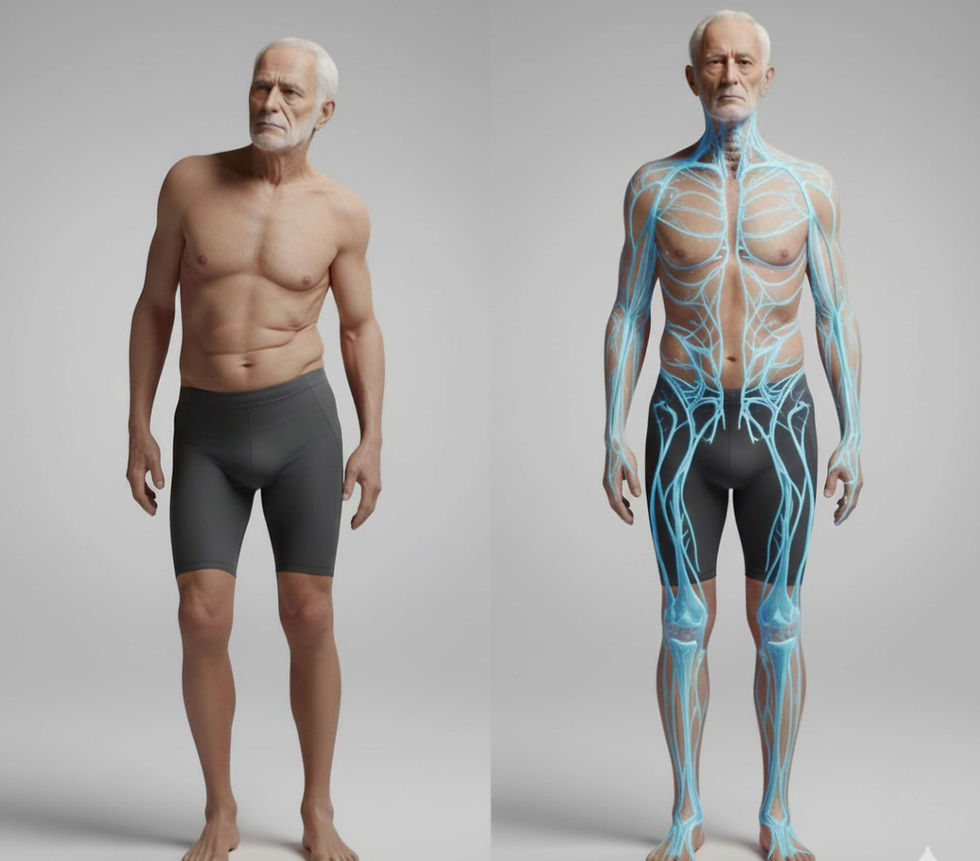
The diaphragm, psoas, deep abdominal fascia, chest, and shoulder girdle form a single functional group for the purposes of internal practice, because all of them are load-bearing within the tensile chain the practice is trying to organise.
A restricted diaphragm breaks the connection between upper and lower body and limits the intra-abdominal pressure variation that whole-body power depends on. A chronically shortened psoas fixes the relationship between spine, pelvis, and leg, constraining the kua before any movement begins. Densified deep abdominal fascia reduces glide at the mechanical centre of the body. And a shoulder girdle held in elevation, scapulae unable to hang and settle onto the ribcage, breaks the connection between arm and torso just as decisively as a locked diaphragm breaks the connection between the halves of the body.
Holding anywhere in this group means force cannot transmit efficiently through the chain. The obstruction is structural, and it cannot be released by attention alone because the tissue itself has adapted to hold the positionhttps://www.taijiquan.quest/post/chen-tai-chi-movement-longevity.
Autonomic signalling
The jaw, face, eyes, and suboccipitals form a second group. These are not primarily load-bearing in the practice, and holding here does not directly interrupt force transmission.
What they do instead is signal. Jaw clenching and orbital tension are among the most reliable somatic markers of sympathetic activation, and they function as a persistent input telling the nervous system that vigilance is still required. A practitioner can have a reasonably organised structural chain and still find deep Song unavailable, because the system is receiving continuous confirmation from the face and jaw that it is not yet safe to release.
The Compounding Mechanism: The Ratchet
Chronic bracing produces fascial remodelling, the tissue adapts to sustained tension, and collagen organisation shifts toward the geometry of the held position. Once that adaptation has occurred, the remodelled configuration becomes the new structural baseline. The tissue does not return to its previous state, because returning would require a remodelling stimulus in the opposite direction, and ordinary daily movement does not provide one.
But the neuromuscular pattern that drove the adaptation is still running. The muscles are still bracing, still pulling in the same direction, now from a position that is already further from neutral than where they started. The tension continues to act on tissue that has already yielded to it, and the tissue continues to adapt.
There is no restoring force anywhere in this system. Nothing pulls the structure back toward its original configuration. The result is a slow, continuous slide in one direction, with the tissue's own adaptation progressively establishing the floor from which the next increment of displacement begins.
This is why postural presentations that appear to be consequences of age are more accurately understood as endpoints of a trajectory. Very few twenty-year-olds are significantly hunched. But a twenty-year-old with chronic scapular retraction and anterior chest holding is already on the slide, and four decades of the same mechanism operating without interruption produces the presentation that gets attributed to getting older. The mechanism was running the entire time. What changed was how far it had travelled.
Everything that happens subsequently feeds this same mechanism. A sedentary decade at a desk does not create a separate problem in a body already organised around chronic defensive bracing, it accelerates the existing slide. An athletic injury produces compensation that stabilises around the holding already present, because the nervous system builds compensation on whatever structural logic is currently in place. Adult stress reactivates the same defensive geometry the body learned in childhood, because that geometry is the body's established answer to threat.
None of these inputs get to choose their own direction. They are absorbed into the directional bias that already exists, and their effect is to move the ratchet further along.
As the structure slides further from neutral, the compensation accumulating around the defensive geometry is organised specifically to support it, which means the foundational holding is progressively buried under structure that exists to protect it. This is one of the reasons corrective remodelling of fascia operates on timescales measured in years rather than months.
This is why two practitioners might have identical adult histories, same sport, same desk job, same injuries, and face completely different structural issues and corrective remodelling requirements. One is feeding inputs into a system with no established bias. The other is feeding them into a ratchet that has been running since childhood. The visible history is the same. The structural situation is vastly differnet.
Conclusion
The practical consequence is that early-established internal-ecology debt produces the longest corrective phase, and it does so for structural reasons rather than as a matter of degree. The foundational pattern is the last thing to become accessible, because everything laid down since has been organised specifically to support it. The sequential process by which that access is earned, and why progress can feel disproportionate to effort for extended periods, is set out in Hierarchical Interoceptive Unmasking.
None of this is fault, and none of it is pathology. A developing nervous system that braces in a threatening environment is functioning correctly. It is doing precisely what it evolved to do, and the resulting structure was an accurate solution to the conditions that produced it. The difficulty is only that the solution outlived the problem, and that a solution built during development is not a layer that can be peeled away. It is the shape the body took.
Understanding this changes what the corrective phase actually is. It is not the removal of bad habits or the correction of poor posture. It is the slow dismantling of an architecture that was assembled carefully, over years, by a system doing its best with the information it had, and the gradual construction of a new organising logic to replace it.
Comments