The Embodied Mind: Structure, Sensation, and Somatic Memory
Updated: Aug 13
The Fascial Network as the Interoceptive Modulator and Memory Layer of the Mind-Body System
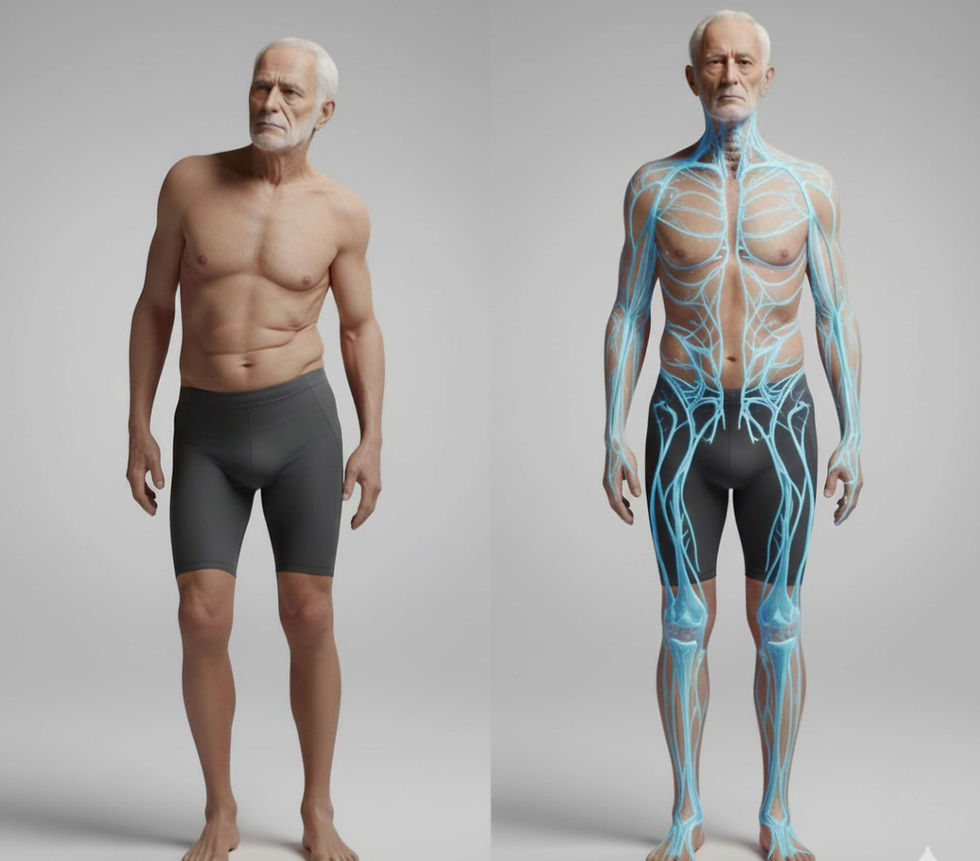
Fascia is not simply the tissue that wraps and connects the body's structures. It is the primary medium through which mind and body become a single integrated system, not metaphorically, but mechanically and neurologically. This unification is always present to some degree; body and mind are never fully separate.
The mind-body system is designed for complete resolution, activation discharges, defensive responses switch off, and tension patterns dissolve back into baseline. What we are concerned with here is the subset of experience that does not resolve, activation that fails to discharge, defensive responses that never fully switch off, tension patterns that begin as momentary and end, through repetition and reinforcement, as permanent features of the body's architecture.
When this happens, the fascial system is the medium in which it happens. Fascia is where unresolved activation becomes structure, where psychological disposition and physical holding patterns gradually cease to be two things and become one. It is the anatomical and neurological bridge that translates emotional history into physical posture. And because no two bodies share the same developmental history, injury patterns, or defensive strategies, the amount and distribution of maladaptive fascia varies widely between individuals. Understanding this process, how it occurs, what it produces, and how it can be reversed, is central to what vitality, in its deepest sense, actually requires.
1. Fascia as the Substrate of Internal Sensation
The body cannot reorganise what it cannot feel. Fascia is the primary organ through which the body feels itself.
Unlike muscle, which is relatively sparse in sensory endings, fascia is densely packed with mechanoreceptors: Ruffini endings that respond to sustained lateral stretch and are directly linked to autonomic tone; Pacinian corpuscles that detect rapid pressure change and vibration; Golgi endings that monitor tensile load across the myofascial junction. These receptors continuously feed data to the brain regions responsible for self-awareness, threat assessment, and emotional regulation. Fascia functions as the body's primary radar network, not for the external environment, but for the internal one.
This is the distinction between proprioception and interoception. Proprioception tells you where your limbs are in space. Interoception tells you what is happening inside: tissue tension, visceral pressure, the quality of breath, the subtle shift in internal pressure that precedes fatigue or ease. Fascia is the dominant carrier of interoceptive information. It is the tissue through which the body knows itself.
When fascia is hydrated, elastic, and free to glide, this internal communication is clear. Movement feels effortless because the nervous system receives accurate, unambiguous feedback and can coordinate accordingly. When fascia is maladapted, densified, restricted, or functionally isolated through Biomechanical Debt, that signal degrades. The nervous system receives noise instead of information. Interoceptive resolution drops. The practitioner loses access to subtler layers of sensation because the tissue through which such sensation is mediated has become structurally compromised.
How fascia becomes compromised in this way, and why it is so resistant to change once it does, is what the following section addresses.
2. How Activation Becomes Structure
The process by which activation becomes structure is not a single mechanism but a set of interlocking ones, each reinforcing the others. Understanding them together, how tissue adapts, where the deepest holdings accumulate, how the autonomic system becomes entangled, and what the resulting architecture looks like, is what makes the difference between addressing isolated aspects and addressing the system as a whole.
A. The Mechanism of Imprinting
Mind and body are always unified at some level, this is not a claim that requires argument. What does require explanation is how that unity sometimes produces permanent structural consequences and sometimes does not.
The answer lies in resolution. The nervous system is designed for complete resolution. When activation discharges fully, the body responds, the tension releases, and baseline is restored without structural trace, no imprint remains. This is the healthy cycle, and it is what the system is built for.
What produces somatic imprinting is not the intensity of the activation but its failure to resolve. When a defensive response, visceral bracing, breath restriction, characteristic holding in the psoas or diaphragm, is suppressed rather than discharged, repeated without resolution, or overwhelms the system's capacity to integrate, it does not return fully to baseline. A residual tension remains. That tension, over time, begins to reshape the connective tissue around it. The fascia adapts to the held state, gradually densifying and losing elasticity in the configuration of the original defensive response.
This is not metaphor. Fascial tissue responds to mechanical load through fibroblast activity, sustained tension shifts the collagen architecture toward the geometry of the held pattern. The tissue becomes a structural record of what the nervous system could not fully release. Crucially, this restructured tissue then feeds altered afferent signals (sensory signals travelling from body to brain) back to the brain, subtly biasing the nervous system toward the original defensive state. The holding pattern becomes self-referencing: the structure reinforces the neural bias, and the neural bias reinforces the structure. This is the Myofascial Lock, and it is what makes these patterns feel intractable. It is not mind influencing body, or body influencing mind, but a single self-sustaining system operating simultaneously in both directions. It behaves like character rather than habit precisely because it is no longer located in either domain alone.
When these patterns are established early in life, during developmental periods when the nervous system is most plastic and most dependent on the environment for calibration, they can profoundly shape the bodymind's fundamental architecture.
B. The Visceral Core as Primary Anchor
The body's oldest and deepest defensive patterns are housed in the visceral core: the diaphragm, psoas, and deep abdominal musculature. This region is mechanically central to survival, it stabilises the spine, protects vital organs, and governs breath, and the nervous system therefore maintains a higher baseline tone here than almost anywhere else in the body.
When threat is perceived, real or remembered, the visceral core is the first to brace and the last to release. Chronic activation here produces some of the densest fascial adaptation in the body: restricted diaphragmatic movement, reduced glide in the deep abdominal fascia, and a progressive stiffening of the structures closest to the body's mechanical and emotional core. Even in bodies that appear flexible or relaxed in the periphery, the visceral core often retains a degree of hard-wired stiffness that reflects its role as the primary structural anchor of defensive physiology.
This is also the region most resistant to voluntary release, for the same reason it is most prone to holding: the nervous system will not relinquish tone here until it senses sufficient structural support to do so safely.
C. The Fascia-Autonomic Link
The deep core fascia is not only mechanically central, it is neurologically entangled with the autonomic nervous system in ways that make fascial restriction and dysregulation mutually reinforcing. Chronic bracing in the visceral core directly affects the vagus nerve, which passes through the diaphragm and branches extensively through the abdominal cavity on its path from brainstem to gut, compressing and restricting the tissue surrounding it, and degrading its capacity to signal that threat has passed and regulation is safe. The result is a nervous system that defaults toward low-grade alert rather than parasympathetic ease, not because of ongoing threat, but because the structural environment no longer supports the signal that threat has passed.
The mechanism behind this entanglement, and specifically how fascial restriction degrades the sensory signals the vagus nerve carries toward the brain, is explored in The Upward Signal. The downstream consequences for autonomic regulation and long-term health are covered in The Parasympathetic Advantage. The key point for the present discussion is that fascial restriction and autonomic dysregulation are not cause and effect but co-arising features of the same coupled system. Releasing one without addressing the other produces incomplete and often temporary results.
D. The Distribution of Debt
The coupled loop described above does not stay contained. The visceral core is its deepest seat, the place where the oldest and most neurologically entrenched holdings live, but the pattern extends outward through the fascial chains into the shoulders, neck, jaw, and hip flexors and beyond. Each peripheral holding is typically either a direct extension of the core bracing pattern radiating outward, or a compensatory adaptation to the restriction at the centre. The periphery and the core reinforce each other, which is why addressing only the outer holdings produces limited and often temporary results. The debt is distributed, but it has a source.
3. Reconnecting Through Fascial Awareness
Adult fascial patterns reflect accumulated history: defensive responses that became habits, habits that became structure, structure that became the body's unconscious baseline. Changing them requires working in the medium in which they are encoded. Thought and intention cannot unwind what has become structural, but conscious activation through tissue can.
In Chen Taijiquan, this process unfolds through global, integrated movement rather than localised release. As practice deepens, movements that once felt peripheral, the spiral of the arm, the extension through the shoulder, begin to transmit tensile stress through the continuous fascial web, carrying that load into the back, the abdomen, the deep core holdings that the deep core holdings that deliberate local release may struggle to reach directly. The release is no longer a local event; it is a systemic reorganisation.
This process is not linear. Deeper holdings are typically masked by more superficial or neurologically dominant compensations. The nervous system will not expose a foundational pattern until the layers above it have quieted sufficiently to be safe. This is the logic of Hierarchical Interoceptive Unmasking: a progression in which each layer of release reveals the next, and sensitivity deepens not through effort but through the progressive clearing of structural interference.
As fascial tissue in the core becomes more responsive, interoceptive resolution sharpens. The nervous system begins to receive cleaner information from deeper within the body. Subtler and subtler layers of held pattern become accessible as the channel through which sensation travels becomes progressively restored.
Conclusion: The Body's History, and the Path Beyond It
Maladapted fascial patterns are not a collection of tight muscles. They are a self-reinforcing structural history, unresolved activations that became encoded in tissue, tissue that became neural bias, neural bias that became what feels like character. This is Biomechanical Debt: not a mechanical inconvenience but a living constraint on the nervous system's capacity for ease, emotional resilience, and genuine self-regulation.
This is why willpower fails. The body's unconscious defensive posture, its fossilised holdings, continue to shape physiology regardless of conscious intention. The mind cannot outthink a structural constraint, because the constraint is not located in the mind alone. It is the mind, expressed in tissue.
The internal work of Chen Tai Chi is therefore a process of somatic reintegration: not overcoming the body's history, but meeting it in the medium where it lives, and gradually offering it something new. Movement becomes the language through which the nervous system is invited, not forced, to revise its oldest assumptions about safety and structure.
Over time, this reduces the cumulative mechanical and neurological load the body carries. Ease becomes available as the natural condition of a system no longer spending its resources maintaining its own defences. This is what vitality means, in its most concrete sense: not energy added, but interference removed.
Fascia is more than connective tissue. It is memory, intelligence, and sensation woven into a living web. Engaging it consciously, with patience, precision, and the willingness to meet what has been held, allows the practitioner to restore not just movement, but the full felt sense of being alive. The body tells the story. Fascia is the ink. By cultivating awareness of this living network, we learn not just to move better, but to feel, remember, and inhabit our lives fully.

Comments